
Donald Trump on the precipice of overturning a more than centuries old precedent, markedly escalating the Administration’s deportation efforts; working to dismantle Birthright Citizenship and launching ICE agents at legal citizens in courtrooms.
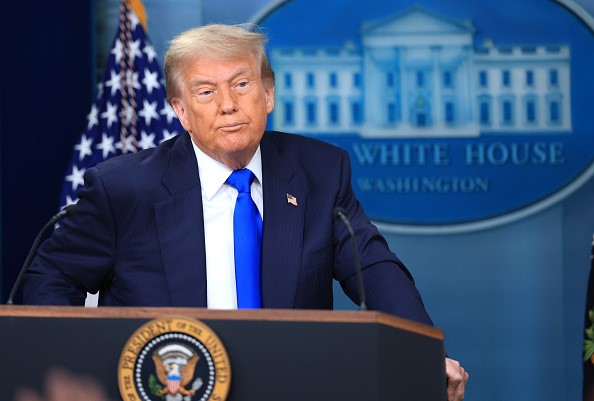
WASHINGTON, DC – JUNE 27: U.S. President Donald Trump answers questions during a press conference on recent Supreme Court rulings in the briefing room at the White House on June 27, 2025, in Washington, DC. The Supreme Court ruled 6-3 that individual judges cannot grant nationwide injunctions to block executive orders, including the injunction on President Trump’s effort to eliminate birthright citizenship in the U.S. The justices did not rule on Trump’s order to end birthright citizenship but stopped his order from taking effect for 30 days. (Photo by Joe Raedle/Getty Images)
Maliyah Simone, CRDN
December 22, 2025
The Trump administration has pursued a dual strategy aimed at fundamentally restructuring U.S. immigration policy, combining an aggressive ramp-up of deportations by Immigration and Customs Enforcement (ICE) with a legal effort to challenge birthright citizenship, a guarantee rooted in the Fourteenth Amendment. This legal initiative centers on overturning a key 1898 Supreme Court precedent deciding in U.S. v. Wong Kim Ark, 169 U.S. 649 (1898), by drawing upon an older ruling concerning Native American citizenship in Elk v. Wilkins 112 U.S. 94 (1884). Decided about 14 years earlier, Elk holds that Native Americans were not allowed to become citizens of the United States pursuant to the birthright citizenship provision of the Fourteenth Amendment of the U.S. Constitution. Instead, the U.S. Congress enacted a statute, that specifically granted Native Americans and their decedents, U.S. Citizenship. Conversely, fourteen years later, the U.S. Supreme Court held in Wong Kim Ark, that the petitioner, born in the U.S. to parents who illegally entered the U.S., and were of illegal status, citizenship as a birthright pursuant to the birthright citizenship provision of the Fourteenth Amendment of the U.S. Constitution. The diametrically opposed cases set the stage for a class conflict, which the current U.S. Supreme Court must decide, which is correct.
U.S. Immigration and Customs Enforcement (ICE) has reported a significant increase in enforcement and removal operations across the country. This intensification followed the reversal of certain policies regarding arrests in “sensitive locations” such as schools, hospitals, and places of worship. Administration officials publicly confirmed the establishment of aggressive goals for daily immigrant arrests and removals, a goal that was reported by multiple news outlets as high as 3,000 migrants per day during discussions in 2024.
A Department of Homeland Security official has been quoted stating, “We have deported known terrorists, cartel members, and gang members from our country,” and indicated a commitment to seeing deportation figures continue to rise.
This operational shift has included expanded use of tactics such as targeted arrests in courthouses and increased reliance on deputized state and local law enforcement agencies through the 287(g) program. Experts, including Jesse Franzblau, Associate Director of Policy for the National Immigrant Justice Center, have noted the far-reaching effects, describing the “sweeping ICE raids and arrests” as impacting families and communities widely. Additionally, the administration has sought to expand the use of expedited removal, a process allowing for fast-track deportations, to apply to noncitizens across the nation.
The administration’s legal challenge targets the Fourteenth Amendment’s Citizenship Clause: “All persons born or naturalized in the United States, and subject to the jurisdiction thereof, are citizens of the United States.”
The goal is to undermine the landmark 1898 Supreme Court ruling, United States v. Wong Kim Ark.
In United States v. Wong Kim Ark, 169 U.S. 649 (1898), established the broad principle of birthright citizenship for the children of immigrants. The case involved Wong Kim Ark, who was born in San Francisco to Chinese immigrant parents and was subsequently denied re-entry to the U.S. as a non-citizen. The Supreme Court ruled in favor of Wong, confirming his status as a U.S. citizen. The Court explicitly interpreted the “subject to the jurisdiction thereof” clause to exclude only the children of foreign diplomats and members of hostile armies or Indian tribes, effectively rejecting arguments that the clause should apply to children of all resident aliens.
The ruling affirmed that children born in the U.S. to parents permanently residing there—even if the parents were ineligible for naturalization—were fully subject to U.S. laws and jurisdiction, thereby securing birthright citizenship under the Fourteenth Amendment.
The case of Elk v. Wilkins, 112 U.S. 94 (1884), addressed the question of Native American citizenship under the Fourteenth Amendment. The litigant, John Elk, was a Native American man who had left his tribe and resided among the general population in Omaha, Nebraska, and sought to register to vote. The Supreme Court ruled against Elk, holding that Native Americans who maintained a political relationship with their tribes were not fully “subject to the jurisdiction” of the United States as defined by the Citizenship Clause.
The Court reasoned that Native Americans belonged to distinct, dependent political communities, and therefore did not automatically gain citizenship upon birth, establishing a narrow interpretation of the clause rooted in the peculiar legal status of Indian tribes.
Now, the administration’s current legal argument relies heavily on reinterpreting the 1884 decision in Elk v. Wilkins. Administration proponents argue that this specific exclusion should be extended to children born in the U.S. to parents who are either undocumented or temporary residents, thus reversing the Wong Kim Ark precedent.
Legal scholars largely reject the proposed application of the Elk precedent. The Court in Wong Kim Ark explicitly distinguished its finding from Elk v. Wilkins, limiting the Elk decision to the unique legal status of members of recognized Indian tribes. Legal analysis consistently holds that the attempt to apply the Elk reasoning to the children of resident non-citizens directly contradicts the binding precedent set by Wong Kim Ark. The impending outcome of this constitutional challenge, which now reached the Supreme Court, has the potential to fundamentally alter the definition of U.S. citizenship for millions of individuals born on U.S. soil.