
AI’s benefits are hard to virtually impossible to ignore. So, too are AI’s negatives, causing increasingly worrisome concerns regarding jobs, and whether AI would one day seek to subvert the control Humans.
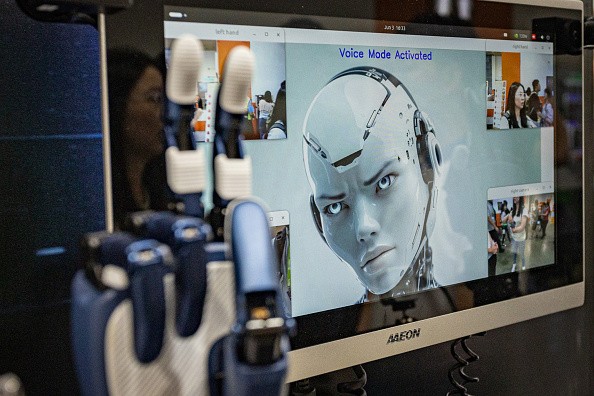
TAIPEI, TAIWAN – JUNE 03: An interactive artificial intelligence display system showing an AI interface with “Voice Mode Activated” is presented alongside a robotic hand controller on June 03, 2026, in Taipei, Taiwan. Running June 2–5 across four venues in Taipei’s Nangang and Xinyi districts under the theme “AI Together,” the annual trade show has drawn more than 1,500 exhibitors and industry heavyweights including NVIDIA CEO Jensen Huang to showcase next-generation AI chips, robotics, and computing infrastructure, cementing Taiwan’s role as the world’s pre-eminent hub for semiconductor and AI supply chain innovation. (Photo by Cheng Chia Huang/Getty Images)
Jade Lopez, CRDN
June 8, 2026
Chatbots, artificial intelligence (AI) platforms, and imaging generators—once a niche and incomprehensible concepts –have rapidly become integrated into our daily workflows and lifestyles.
Everything from political environments to small businesses to places of education and employment utilize varying versions of AI. Many tech firms and governments are even heavily investing in data centers (the facilities that store and run these systems) and the infrastructure needed to support them. These centers require intense amounts of computing power, and their increasing expansion has been fast enough to put lots of pressure on energy grids and local resources.
The development of AI over the past year alone has been dramatic, and it’s perfectly fine to feel both excited and unsure about this. In such a short span of time, intelligence tools have moved from simple technology into necessities for everyday life. These systems have become increasingly powerful. Modern AI models can juggle numerous types of input—images, texts, video, voice notes, and it’s embedded into tons of software, social media platforms, and search engines. Artificial Intelligence has very clear advantages in its capabilities. It eliminates (sometimes mundanely) time-consuming tasks—everything from writing an email, creating a work presentation, coding, data analysis, etc.
It’s also rapidly improving and accelerating scientific and medical progress. It helps researchers with climate modeling, creating new drug formulas, and detecting new diagnostics. “According to Gallup’s latest survey, 45% of Chief Human Resources Officers (“CHROs” say their organization’s operational efficiency have improved because of AI. Other recent studies have found that workers can answer more customer requests and write more documentation and code with the assistance of AI.”
In addition, AI is making information and services more accessible through better translation tools, tutoring systems, and assistive technologies. Economically, it’s creating new industries and opportunities, even if those benefits are unevenly distributed. AI can even improve accuracy. Robots, as is the case with humans, can and do make mistakes. However, unlike humans, Robots, more commonly referred to as “Humanoids,” do not forget anything they’ve been told, and are incapable of feeling real emotion.
There are also significant challenges and drawbacks with AI as well. For one, it is reshaping the job market. Since misinformation spreads rapidly, these artificial intelligence systems make it easier to generate false content and even deepfakes. Additionally, a small number of extremely powerful tech companies control the majority of the infrastructure, which is deeply concerning when one considers the power of AI and data centers. There is a risk that people have become too reliant on AI—eliminating any critical thinking skills.
The environmental impact: AI systems run in data centers. The servers in those centers generate a ton of heat, so many of these centers rely on water-based cooling systems. This is a heavy consumption of water–both for the cooling and electricity that it uses. Even though a single interaction with an AI chatbot uses a small bit of water, the effect it has from its billions of users adds up quickly. In some cases, large data centers can use millions of gallons of water per day.
Energy consumption is another major factor. AI systems require large amounts of electricity, and depending on how that electricity is generated, this can lead to substantial carbon emissions. One concern is that some data centers are being built in regions that are already facing water shortages, which creates issues with local communities over resource use. Companies are working on solutions, such as using renewable energy, improving hardware efficiency, and switching to recycled or non-potable water for cooling. However, the challenge is that while efficiency has been improving, the demand for AI is growing even faster, which can offset those gains.
AI systems require significant energy and water, especially at the scale of global data centers. While an individual use has a small footprint, the rapid growth in demand is putting pressure on resources and infrastructure. The issue isn’t just that AI consumes resources—it’s how quickly its usage is expanding compared to how fast efficiency and sustainability measures are improving.
With all of this being said, I wouldn’t label AI as “good” or “bad” in simple terms. It’s delivering clear benefits for society: boosting productivity, aiding in medical and scientific development, expanding access to educational tools, and allowing more access to knowledge. Things that once took hours can now take minutes, and tools that were limited to experts are now widely available. At the same time, those strengths create real risks. AI can speed up job disruption, spread misinformation, concentrate power in a few large companies, and encourage overreliance, as many people substitute it for their own thinking.
The most grounded conclusion is that AI is becoming foundational infrastructure, similar to the internet or electricity, and its long-term impact depends on how it’s managed. If developed responsibly, it could expand access to education and healthcare and help solve complex global problems. If handled poorly, it risks deepening inequality, straining the environment, and eroding trust in information. The outcome isn’t fixed yet, but it looks like the direction it’s headed is a scary one.