
AI’s benefits are hard to virtually impossible to ignore. So, too are AI’s negatives, causing increasingly worrisome concerns regarding jobs, and whether AI would one day seek to subvert the control Humans.
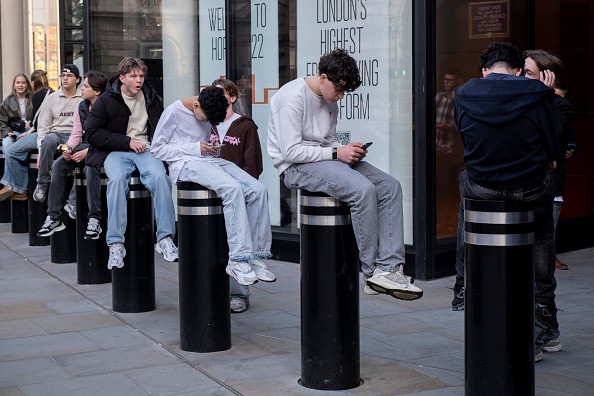
Young People on Bollards with Smartphones in London
Several young people sitting on top of bollards on Bishopsgate looking at their smartphones on 25th February 2026 in London, United Kingdom. (photo by Mike Kemp/In Pictures via Getty Images)
Jade Lopez, CRDN
June 8, 2026
We’ve all seen it—a group of friends sitting at a table, and every single person is on their phone. One is scrolling videos on TikTok. The other is looking at someone’s photo dump, someone who is practically a stranger to them on Instagram, and comparing their own life to what they’re seeing. The other is on YouTube, watching their favorite streamer play video games. These people are together… physically… but mentally, they’re somewhere else.
For my generation specifically, this is a constant.
94% to 98% of Gen Z uses at least one form of social media daily as of 2026. There are approximately 2 billion individuals in this generation. We make up about 23% of the world’s population, which has about 8.3 billion people currently.
Social media isn’t just a tool for us, it’s a lifestyle and our environment. It’s how we stay connected to people from across the globe. It’s how we maintain relationships with those people we met travelling in foreign countries, where inside jokes and memes are spread in hours—a viral video I laughed at from my bedroom in New York City, a little girl in Finland who doesn’t speak my language is also laughing at.
It’s where you learn how to cook dishes from an Italian grandma, do DIY projects, fix a car problem from a retired mechanic, get outfit inspirations from Parisian fashion designers, get step-by-step instructions on how to play piano, and learn Dutch from a college student in the Netherlands. It creates this sense of closeness, even when we’re on opposite sides of the Earth. Proximity and shared language doesn’t play a part—humor, trends, and tips and tricks move faster than words. We’ve turned the internet into a shared cultural space.
There is something so beautiful in that.
People have found comfort and communities in places they may have never had access to otherwise. Someone looking for guidance in something so niche such as crocheting bumblebees has now found other people wanting to do the same thing. It feels like the world has opened up in a way like never before.
On the other side of that coin, however, is something unsettling—how people see themselves. Filtered faces and edited bodies have created unrealistic beauty standards for men and women that we see everyday. That bikini photo of your favorite influencer is the reason you’ll skip dinner tonight. You’ll look in the mirror and see someone who looks nothing like what you just saw on Instagram, and question why you can’t be skinny like her.
Bodies start to look like projects instead of people. Lives start to feel like performances instead of experiences. You don’t just see others—you measure yourself against them. And the comparison never really ends, because there’s always more to scroll.
That video of a guy from high school flying on private jets, that girl posting travel highlights every month, that person getting thousands of likes and comments on how amazing they look—all the things you don’t have or do—greatly impacts our self-worth and perspective.
The algorithm plays its part, even if you don’t notice it. It learns what holds your attention—what makes you pause, what makes you feel something—and then gives you more of it. Sometimes that means helpful content, like tutorials or motivation. Other times it means content that keeps you hooked in less healthy ways: insecurity, repetition, or frustration. It’s not designed to ask what’s good for you. It’s designed to keep you there.
Beyond all of this, there’s another layer that many of us don’t see or think about—advertisements. Sometimes they’re subtle or undetected, and other times you’ll think to yourself, “I was just thinking about this! How did my phone know?” Products show up immediately after you talk about them. Maybe this has created an awareness that your behavior is being tracked, analyzed, and used.
For some of us, that feeling extends further into concerns about surveillance and control. Who’s watching, who’s collecting, who’s listening, and what it all really means.
But does that deter us? Not really. We stare anyway. Not because we’re unaware of the downsides of social media, but because the benefits are real too. It’s where people connect, learn, laugh, and can express themselves freely. It’s where culture is created in real time. Leaving it entirely would feel like stepping out of the conversation, like missing a piece of the world as it’s happening.
Gen Z grows up in this balance. One between connection and comparison, creativity and pressure, freedom and surveillance. Social media isn’t just something they use; it’s something that shapes how they understand identity, relationships, and reality itself. The challenge isn’t simply deciding whether it’s good or bad. It’s figuring out how to live inside it without letting it define everything.
As a society, we’re all learning and growing each day. From the middle schooler in Argentina, to the famous athlete in Korea, to the retired Navy veteran in California—I think we continue to use these platforms because it’s one of the only things we have in common, a shared sense of community.