
The Rise of Cancer Deaths Worldwide, including in the United States, Characterized by Medical Professionals Misrepresenting Decreases in Cancer Deaths as Reflections of Advances in Science, Masks Perhaps One of the Most Harmful Negative Impacts of Global Warming and Unrestrained Capitalism.
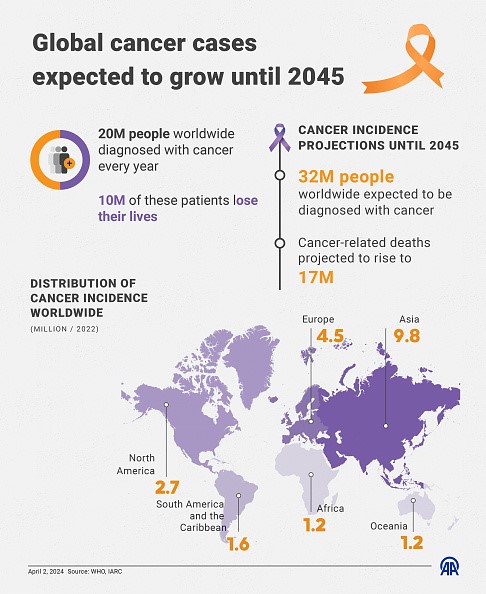
Global cancer cases expected to grow until 2045
ANKARA, TURKIYE – APRIL 2: An infographic titled ‘Global cancer cases expected to grow until 2045’ created in Ankara, Turkiye on April 2, 2024. 32M people worldwide expected to be diagnosed with cancer until 2045. (Photo by Elif Acar/Anadolu via Getty Images)
Jade Lopez, CRDN
August 22, 2025
This year, over two million people will be diagnosed with cancer in the United States alone. It’s estimated that over 600,000 people will die from the disease across the country, with lung cancer being the leading cause of death among men and women.
There are over 200 different types of cancers, with breast cancer being the most diagnosed in women and prostate cancer being the most diagnosed in men. Cancer is the second leading cause of death across the nation, falling just behind heart disease.
Over the past century, the broad landscape of cancer has undergone drastic changes, including new extensive research, diagnostic practices, medical technology, and an overall altered perspective of the killer.
Before the 1940s, cancer specialists worked with a significantly limited set of tools and resources compared to the present day. This means cancer was likely less detected, reported, and misclassified as a different cause of death.
When we think of diagnostic techniques used 80 years ago, very few come to mind. X-rays were used, but not nearly to the extent we have now. Modern technology now offers MRIs, CT scans, PET scans, and ultrasounds (used to detect new cancers that weren’t diagnosed before).
Thanks to an evolution in this technology, these advanced machines offer early detection (stages 1 or 2), in comparison to the 1940s, when cancer wasn’t detected until the later stages, which oftentimes, was too late.
One of the most prominent contributors to the rising cancer deaths and diagnosis rates is the shift in demographics. In the 1940s, the average lifespan was considerably lower than it is today.
With the advent of better healthcare, improved sanitation, vaccines, and antibiotic treatments, human longevity increased dramatically over the succeeding decades. The most
cancer-diagnosed age group is those 65 and older.
The older population experiences higher cancer rates simply because there is more time for cellular damage to accumulate, resulting in malignant transformations.
Those under 20 years of age only account for 1% of all cancer diagnoses, and those under 40 years of age account for less than 5% of all cancer diagnoses.
This shift in demographics has significantly impacted public health policy and resource distribution, leading to greater investment in research on age-related illnesses and the underlying causes of cancer.
We also cannot rule out lifestyle choices in the rise of cases and deaths. As lung cancer is the leading cancer killer, it’s important to note a few things:
- Tobacco Use: The aggressive marketing of tobacco products, coupled with a limited understanding of their health risks, led to widespread Decades later, research conclusively linked cigarette smoking to a higher risk of lung cancer, as well as several other malignancies.
- Diet and Obesity: Over 40% of Americans over the age of 20 are considered obese, and over 15% of the world’s population fits into that category. Overindulgence in processed food, large fatty portion sizes and high-calorie diets is directly correlated to sloth-like lifestyles, and an increase in colorectal, breast, and pancreatic cancers.
- Alcohol: Excessive alcohol use is linked to increased risks of cancers of the liver, esophagus, and breast, among others.
Environmental factors play a significant role in increasing cancer risk by exposing individuals to carcinogens, which are known cancer links. Depending on which country (or state) you live in, your exposure to factors such as air and water pollution, pesticides (specifically those on produce), sun damage, or contamination from materials are more prevalent. Then there is the current revelation that plastics, when heated dissolve, causing what is called Plastic Migration, causing microplastic forever chemicals to mix with the food contained in the plastic containers, all of which is later ingested through human consumption..
People residing near factories, waste sites, or areas impacted by poor air quality are particularly at risk. Therefore, environmental health and regulations play a crucial role in cancer prevention.
The development of screening programs (i.e., mammograms, colonoscopies, endoscopies, pap smears, etc.) has had a dual impact. On one hand, these routine checks allow for early detection and better prognosis; however, the statistical picture of cancer mortality becomes more complex. The rise in cancer deaths is a function of better data collection and a wider cancer spectrum.
Treatments such as chemotherapy, radiation therapy, and surgical techniques have all advanced over time. As cancer cases rose, so did scientific research and public health campaigns. Over seven billion dollars are allocated and raised towards cancer research each year.
When discussing post-1940s cancer cases, access to healthcare, resources, and preventive services, and education has jumped across varying communities. Marginalized and underrepresented populations often face higher exposure to risk factors and have less access to early detection and advanced treatments.
Studies have shown that those in lower socioeconomic classes and certain ethnic groups experience higher rates of certain cancer deaths. These disparities underline the importance of targeted public health interventions that address not only the biological aspects of the disease but also the social determinants of health.
Since the 40s, rising cancer deaths have led to major public health campaigns to reduce exposure through anti-smoking laws, better workplace safety, promoting healthy eating, and early cancer screenings (like recommending colonoscopies to those over 40 years of age).
Moving forward, the focus must be on prevention, early detection, and advanced treatments. We can only hope that, despite the current political climate of our nation, one day, we can find a cure.