
China’s national efforts to build on their “green initiatives” is already reaping the benefits, making them first in the race towards renewable energy initiatives.
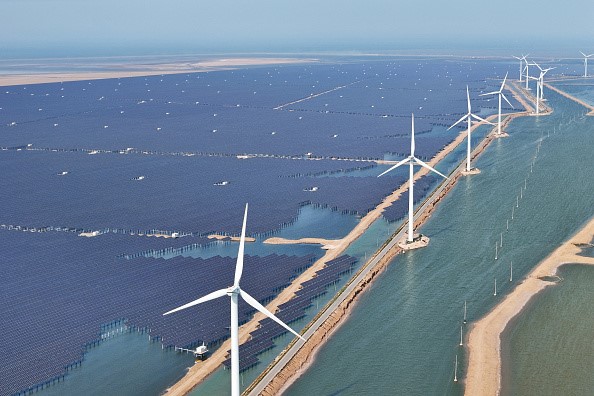
Solar panels and wind turbines are seen at the Huaneng Binzhou new energy power generation project in Binzhou, in China’s eastern Shandong province on June 11, 2025. (Photo by AFP) / China OUT (Photo by STR/AFP via Getty Images)
Maliyah Simone, CRDN
August 25, 2025
In the global race to transition to clean energy, China has emerged as the frontrunner, demonstrating investment and implementation that is significantly outpacing the United States. While both nations acknowledge the critical need for renewable energy development in order to combat climate change and ensure energy security, China’s aggressive approach has resulted in a surge in its clean energy capacity, particularly in solar and wind power.
By the end of 2024, China’s utility-scale solar capacity alone reached over 880 gigawatts (GW)— more than double the 121 GW installed in the United States. This rapid development is a testament to China’s goals and execution.
In 2024 China added an astonishing 277 GW of solar capacity, representing a 45.2% increase in its total solar capacity, and 80 GW of wind capacity, an 18% increase. This expansion meant that by the end of 2024 China had already surpassed its 2030 goal of installing at least 1,200 GW of solar and wind power, achieving this milestone six years ahead of schedule.
Renewable energy now accounts for 56% of China’s total installed power capacity, reaching 1.889 terawatts (TW) by the end of 2024. This marks the second consecutive year that renewable energy generation capacity has exceeded half of the country’s total. Meanwhile, despite the U.S. seeing growth in its renewable sector, it remains a distant second to China.
A key factor in China’s quick progress is its commitment and sustained investment in the sector. In 2024, China attracted over $290 billion in clean energy investments, nearly three times the approximately $97 billion invested by the United States, according to the REN21 Global Status Report 2025. This substantial financial commitment is supported by widespread governmental policies and strategic national planning.
China’s “Dual Carbon” goals, which aim to peak carbon emissions by 2030 and achieve carbon neutrality by 2060, have provided a clear directive for the energy transition. The government’s multi-faceted approach includes strong policy support, such as the Renewable Energy Law, the Clean Energy Development Plan, and a carbon emissions trading system. These policies have not only promoted technology innovation and industrial development but have also facilitated large-scale implementation, including vast solar farms in deserts and initiatives like the “Whole County PV program” to encourage rooftop solar installations in rural areas.
China’s emphasis on energy independence, and its reliance on fossil fuel imports, has fueled its drive for homegrown renewable energy. This move, combined with the growth in its energy demand, makes renewable energy a highly attractive solution for Chinese leadership.
Despite its efforts, China’s energy landscape is not without its challenges. Coal still accounts for a significant portion of its energy mix, and new coal-fired power plants continue to be approved— primarily to meet the surging power demand and balance the intermittency of renewables. Integrating varying renewable power sources into its massive grid remains a complex situation.
However, China’s critical role in the global clean energy supply chain is prominent. Its exports of solar panels, batteries, electric vehicles (EVs), and wind turbines are a substantial impact on global emissions reductions, with 2024 exports alone projected to cut annual CO2 emissions in the rest of the world by 1%.
For the United States, China’s climb in renewable energy is both a challenge and an opportunity. While the U.S. has historically been an innovator in clean energy technologies, it has struggled to maintain the sustained investment and coordinated government support seen in China. The current administration’s push for domestic fossil fuel production and a cautious approach to direct industrial policy for renewables contrasts with China’s top-down strategy.
As the world strives to meet ambitious climate targets, the trajectory of renewable energy development in these two economic giants will continue to be a defining factor. While China charges ahead, its progress highlights the need for accelerated and strategic investment in renewable energy worldwide, including in the United States, to ensure a global and equitable energy transition.