
Many called for the case to be dismissed on the grounds of political retribution; instead, it was an illegal appointment that finally tipped the scales.
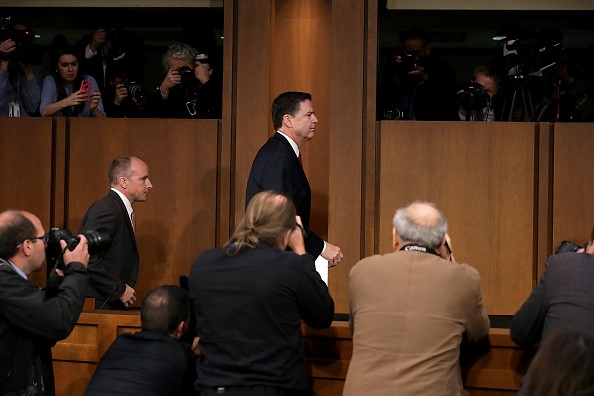
WASHINGTON, DC – JUNE 08: Former FBI Director James Comey (C) leaves after testifying to the Senate Intelligence Committee in the Hart Senate Office Building on Capitol Hill June 8, 2017, in Washington, DC. Comey said that President Donald Trump pressured him to drop the FBI’s investigation into former National Security Advisor Michael Flynn and demanded Comey’s loyalty during the one-on-one meetings he had with president. (Photo by Chip Somodevilla/Getty Images)
Maliyah Simone, CRDN
December 22, 2025
The prosecution of former FBI Director James Comey was abruptly halted and the criminal charges against him dismissed on Monday, November 24, 2025. The dismissal, issued by U.S. District Judge Cameron McGowan Currie, did not address the substance of the charges but instead concluded that the prosecutor who brought the case, Lindsey Halligan, was illegally appointed as the interim U.S. Attorney for the Eastern District of Virginia.
Judge Currie ruled that the attempt by the administration to install Halligan was invalid, concluding that “all actions flowing from Ms. Halligan’s defective appointment”—including securing and signing the indictment—were “unlawful exercises of executive power and must be set aside.”
This ruling supersedes the recent controversy regarding grand jury irregularities, which had dominated prior court hearings before U.S. District Judge Michael Nachmanoff. In those hearings, the Justice Department initially conceded that the final, two-count indictment was not seen or voted on by the full grand jury, before reversing the statement and calling it a clerical error. That procedural dispute, which Comey’s lawyers used to seek dismissal, is now moot.
While the criminal case against Comey is dismissed for now, the Justice Department has announced that it intends to immediately appeal Judge Currie’s ruling. Prosecutors may also attempt to seek a new indictment against Comey using a lawfully appointed prosecutor, though the defense argues the five-year statute of limitations for the charged crimes has now expired.
Background and Political Context
The charges against Comey were filed on September 25, 2025, just days before the five-year statute of limitations was set to expire. He faced two federal felony counts: making a false statement to Congress and obstructing a congressional proceeding. The charges stemmed from testimony Comey gave before the Senate Judiciary Committee in September 2020 regarding media leaks related to the FBI’s investigations.
The prosecution was brought by the U.S. Attorney’s Office for the Eastern District of Virginia (EDVA). The indictment followed the appointment of Lindsey Halligan by Attorney General Pam Bondi, a move that was heavily scrutinized. The appointment occurred following repeated public pressure from President Donald Trump to prosecute his political rivals.
Comey pleaded not guilty and his defense team separately filed motions to dismiss the case entirely, arguing the charges represented a “vindictive and selective prosecution” driven by the documented hostility of President Trump toward Comey.
The Origin of the Feud: Comey, Clinton, and Russia
The deep-seated animosity between James Comey and Donald Trump is the product of a relationship defined by high-stakes political investigations and a dramatic firing, which ultimately set the stage for the current legal battle.
The friction began during the 2016 election when Comey was the Director of the FBI. In late July 2016, Comey announced that the FBI would not recommend charges against Hillary Clinton for her use of a private email server, though he characterized her handling of classified information as “extremely careless.” This decision drew intense criticism from candidate Trump and his supporters, who immediately claimed the legal system was “rigged.” The controversy was amplified just days before the election when Comey informed Congress the FBI was reviewing newly discovered emails, an action both Republicans and Democrats agree had a significant impact on the final election results.
The Loyalty Test and Firing
After Trump won the presidency, the relationship became more personal and transactional. Comey testified that in the early days of the administration, President Trump repeatedly pressed him for a pledge of personal “loyalty” and urged him to “let it go” regarding the FBI’s investigation into former National Security Adviser Michael Flynn’s ties to Russia. Comey documented these interactions in detailed, contemporaneous memos.
The relationship ended abruptly on May 9, 2017, when President Trump abruptly fired Comey, four years into his ten-year term. Although the White House initially cited Comey’s handling of the Clinton email investigation as the reason, President Trump later publicly stated he was thinking of “the Russia thing” when he made the decision. Comey’s dismissal immediately triggered the appointment of Special Counsel Robert Mueller to take over the investigation into Russian interference and possible coordination with the Trump campaign.
Public Animus and Retribution
In the years following his firing, Comey became an outspoken public critic of the President, publishing the book A Higher Loyalty: Truth, Lies, and Leadership and frequently questioning the President’s fitness for office. This led to a sustained, public feud, with the President regularly using social media to attack Comey, deriding him with insults and repeatedly calling on his Attorney General to prosecute him.
This long history of direct political and personal animus formed the central defense argument in Comey’s current legal case, as his lawyers sought to prove that the charges filed in September 2025 were a direct result of political retribution rather than a neutral pursuit of justice.
The Administration Appeals, Quietly
Buoyant as a result of the Trump Administration’s success in the United States Supreme Court, the Trump Administration is undeterred by the dismissal. On Friday, prosecutors defiantly appealed the dismissal the case against Mr. Comey. Despite a trove of losses in lower courts, the Administration has been enormously success in the U.S. Supreme Court.